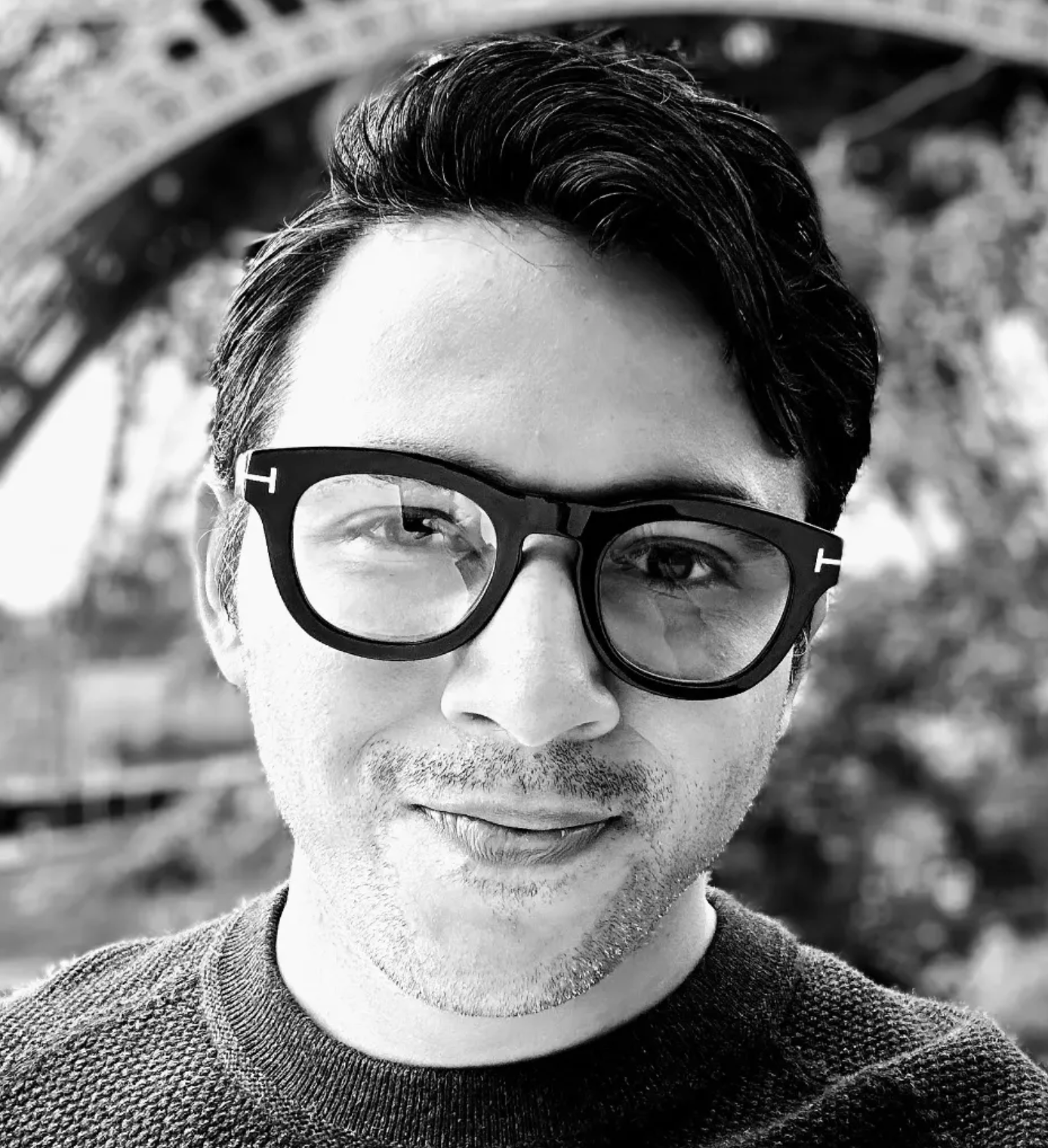
I am interested in the places where organic systems fail gracefully — neural maps, cracked skin, constellations, decay. My paintings are attempts to hold that failure still long enough to look at it. I am colourblind. I have spent my whole life feeling colour rather than naming it. I think that is why I trust it.
I spent years moving, believing that what I was looking for existed somewhere else — in another country, another landscape, another sky. The paintings came out of that exhaustion. Not as escape, but as arrival. For the first time, I was somewhere.
Jung taught me that what we cannot say directly, we say in image. Krishnamurti taught me that clear seeing requires the destruction of what I already think I know. I grew up looking at Eastern miniatures and ornament. I paint in an international abstract grammar. The friction between those two things is, so far, the thing I have most to say.
Rushit Shah was born in Vadodara, Gujarat, on 8 September 1986. He lives and works between India, Singapore, and Germany.
He is colourblind. The work started there — with what colour does against its neighbour rather than what it is called. Weight, temperature, the pressure of one tone pressed next to another. He trusts those signals more than the names.
His path to painting was not direct. He has travelled to more than eighty countries — less as tourism than as extended looking. Deserts, coastlines, markets, ruins, other people's ordinary days. The accumulation of those images, and the losses that came alongside them — including the death of his father — pushed him toward abstraction as the only form capacious enough to hold what he was carrying.
His visual vocabulary sits between two traditions: the ornamental density of Eastern miniature painting, which he grew up inside, and the looser grammar of international abstraction, which he came to later. Much of the tension in the work comes from refusing to choose.